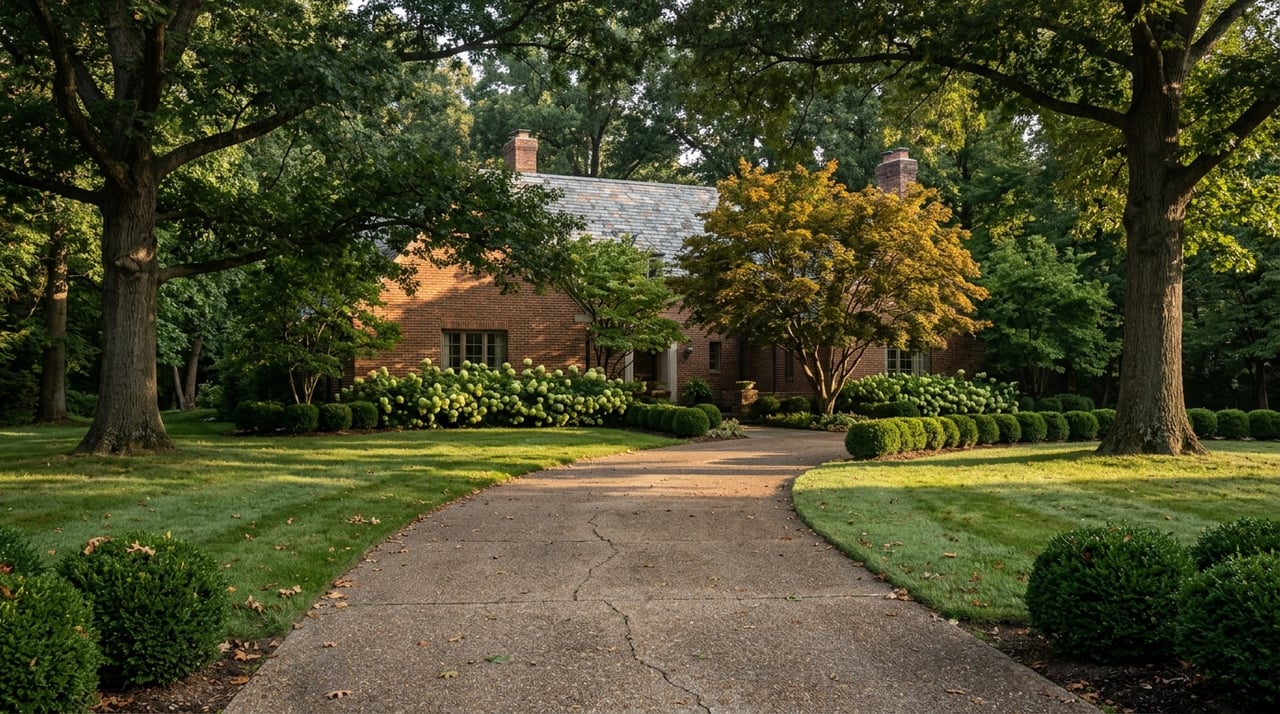
By the third week of August, the tents go up on the grounds of St. Luke Catholic Church, just off North Illinois Street. Folding chairs stack near the school gym. Somebody tests the sound system for the Friday night stage. If you walk the interior streets of Meridian Hills at the same hour, past the country club and the long driveways under the tree canopy, you would never guess anything was coming. That contrast between quiet interior streets and activity near the town's edge reflects a broader feature of Meridian Hills: many of its institutions and landmarks sit near its boundaries.
Meridian Hills incorporated in 1937 for one specific reason: residents wanted zoning power strict enough to keep commercial development out entirely, according to a history compiled by the Encyclopedia of Indianapolis. Meridian Hills has no business district of its own. Several institutions and landmarks—a church, a synagogue, a private school, a restaurant, and a nature preserve—sit near the town's edges.
Three Institutions and Their Zoning Histories
The town's zoning rules also shaped proposals by religious and educational institutions, and each case had a different outcome.
| Year | Institution | What Happened |
|---|---|---|
| 1937 | Town incorporation | Meridian Hills incorporates specifically to adopt zoning that keeps out nonresidential development |
| 1950s | Second Presbyterian Church | The town grants the church its first building permit, then blocks a separate proposal to bridge Williams Creek for access from Illinois Street |
| 1958 | Indianapolis Hebrew Congregation | The town's own plan to run sanitary sewers through the site falls through, clearing the way for the synagogue to be built |
| 1959 to 1961 | St. Luke Catholic Church | The zoning board denies St. Luke's request to build a church, rectory, and school; the case reaches the Indiana Supreme Court, which rules for St. Luke's in February 1961; the church and school open later that year |
The pattern is not random. Second Presbyterian got its church but lost its bridge, a decision that reads like traffic control more than religious objection. The synagogue land dispute resolved itself once the town abandoned an unrelated sewer plan. St. Luke's is the outlier: a flat denial that only got resolved because the case escalated all the way to the state's highest court. Six decades after the zoning board denied St. Luke's a building permit in 1959, the church's grounds host the town's single largest recurring public event.
The Restaurant That Predates The Town By Nine Years
While Meridian Hills was still farmland belonging to the Van Scyoc family and the future site of a country club, a couple named the Vincents were already serving dinner out of a cottage on what is now North College Avenue. Hollyhock Hill opened in 1928, nine years before Meridian Hills existed as an incorporated town at all. It survived a change of hands in 1947 when Hubert "Hugh" Kelso bought it, another in 1992 when the Kelsos handed it to longtime employees Jay and Barbara Snyder, and it is still serving family-style fried chicken dinners today at 8110 N. College Ave, a few minutes' walk from the town line.
The detail that matters for anyone who actually lives nearby: Hollyhock Hill was never built as a neighborhood restaurant. IndyGo's Route 18 runs straight from downtown to its door. It draws from across the metro, the way it always has, which means the fried chicken dinner residents think of as a local fixture has, for nearly a century, belonged to the whole city first and the neighborhood second.
What The Orchard Became
The same edge-of-town pattern shows up in Meridian Hills' green space. Pharmaceutical industrialist J.K. Lilly Sr. bought land at 71st Street and College Avenue in 1896 to plant an orchard. The Lilly family held onto it for decades before donating the property in the mid-1960s to found Park School, a private school for boys that opened in 1967 and merged three years later with Tudor Hall to become Park Tudor. Like the churches, the school landed at the boundary, along College Avenue, not inside the residential core.
Just south of that same corridor sits Marott Woods, a stretch of forest the town shares with Indianapolis at large rather than holds for itself. Indy Parks lists the property at 102 acres, founded in 1961, bordered by College Avenue on the west, the Monon Trail on the east, and a channel of the White River on the south. The Indiana DNR's separate listing for the state-dedicated Marott Park Woods Nature Preserve puts the protected core at 84 acres. The two numbers describe different things: the DNR figure covers only the legally protected old-growth section, permanently off-limits to any future development, nested inside the larger park that Indy Parks maintains for everyday use. Walk the loop trail and you cross from managed park into a patch of remnant forest and back again without any sign marking where one designation ends and the other begins.
None of that acreage belongs to Meridian Hills in any ownership sense. It belongs to the city and the state. The preserve and several landmarks, including Hollyhock Hill, a church, a synagogue, and a school, are located along or near the town's edges.
The Weekend Fall Fest Brings a Crowd
Every third weekend of September, St. Luke Catholic Church runs Fall Fest Weekend, and 2026's dates are set for September 18 and 19. Friday brings an adults-only Bash with music and food. Saturday is Family Fun Day, which the parish's own site says draws more than 1,500 attendees for games, entertainment, and a silent auction that funds school programs, including an eighth-grade trip to Washington, D.C. and a retreat at Camp Rancho Framasa. The parish itself counts roughly 3,500 affiliated members and about 550 students across its K-8 school.
Set that 1,500-person Saturday crowd against the town's own numbers. Meridian Hills counted 1,774 residents in the 2020 census. Williams Creek, the neighboring town most often paired with it, counted around 1,145. That attendance figure exceeds Williams Creek's population, but not Meridian Hills'. Most attendees drive in from elsewhere in the parish's much wider footprint. Fall Fest brings a large gathering to St. Luke's grounds for one weekend each year.
That is the real shape of this neighborhood. Meridian Hills has no business district of its own, and many of its landmarks sit near its edges: Hollyhock Hill, a restaurant older than the town; Marott Woods, with a state-dedicated nature preserve; Park Tudor, developed on donated orchard land; and St. Luke Catholic Church, whose church and school opened after an Indiana Supreme Court ruling in its favor. These places connect the town with the wider area around it.
If you're curious how that history shapes home values and buyer interest in Meridian Hills and Williams Creek today, our team at the Kelly Todd Group tracks both neighborhoods closely, and you can find current listings and local detail on our Meridian Hills/Williams Creek page any time you're ready to talk specifics.
This article is general information, not legal, tax or financial advice. Consult a qualified professional about your situation.